Back to the Mayans.
After our little break, we walked all the way across the East Court to take a look at the surrounding landscape.
 It's been the dry season, but soon the jungle will be even greener. And, again, it's just not the same seeing it in pictures without the sounds of the insects and birds.
 Here is that awesome guy I married checking out Temple 18.
A view of the East Court from Temple 18. Off to the right is where a significant portion of the acropolis collapsed into the river.

Now an opposite view of the East Court. See the little shelter structure on the left? That's Temple 18--the above picture was taken from there. The large pyramid in the picture below is Temple 16, the tallest structure at Copan.

Greg posed above the East Court. Don't forget that the ground would not have been grass and dirt--it would have been plastered, along with everything else.

This view one more time, because why not?

Now, a look at what's to the north of the East and West Courts:
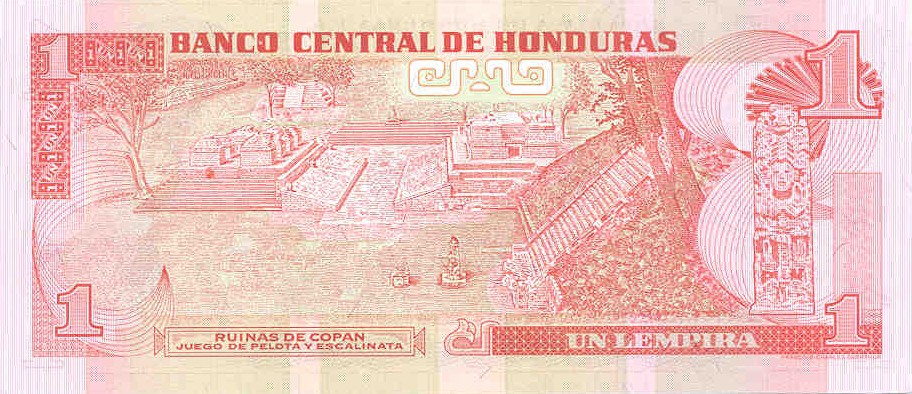
 The above is a view of the Great Plaza. Important stuff! It's lower than the East and West Courts. And it was excavated first. You can see the ball court. That tarp on the right covers the famous hieroglyphic stairway. Take a good look. This is a famous view. So famous that it's on the one lempira bill.
 Don't you want to get down there for a closer look? We did too, so our guide took us down to the Great Plaza.
Careful, don't trip on this guy on the way down.

Guess what! It was our super-dee-dooper lucky day! Let me explain. For hundreds of years moss protected the writing on that staircase. Way to go, moss--because now we can read about the entire history of Copan on those stairs. But when archaeologists removed the moss in order to see/read the writing, they also removed the stairs' protection. So the stairs are ALWAYS covered with a tarp to preserve the fragile glyphs. But remember that huge storm the night before? It damaged the tarp, so it had to be removed and repaired. Yes, the tarp had to be removed. Yippeee! According to the our guide, "The only time they take the tarp off is when National Geographic is coming. So this is very exciting indeed."

This view sans tarp is something you don't get to see often.
 Isn't that stairway pretty darn cool? It's the longest stairway with continuous writing all the way up it in the WHOLE WORLD. (Take that, Greeks and Egyptians!) Also, it is the longest known text of ancient Mayan civilization. Those were some dang cool stairs!
Let's take a look at that writing.
 Of course, there couldn't only be writing.
 My hot, sticky, swollen self in front of the stairway.
 By the way, that skirt gave me an "hermana" tan line. My fellow former sister missionaries in the D.R. (and other places) know what I'm talking about.
 Man, since we were treated to the National Geographic view, why not take another picture?
 And another!
Tired of the hieroglyphic staircase? How about this crumbling staircase?
 The jungle got the best of that stairway.
A Mayan arch.

Next is a picture of the second largest ball court to be found in Central America. There is my husband, standing in the ball court where human heads were kicked around. Was this a romantic anniversary or what? (By the way, it was usually a heavy rubber ball made from latex, and not human heads.)
 Also, the ball game wasn't purely for sport. It was primarily a religious ritual, perhaps symbolizing struggles between different deities.
Before the Mayan glyphs could be deciphered, it was generally assumed that the ancient Maya were a peaceful, science-oriented people. But once great progress was made in deciphering their writing, it was discovered that they weren't quite so tranquil and peace-loving as had been originally imagined. Like...they practiced human sacrifice. Oops--that came as a big to surprise to some old school Mayan scholars.
For example, they would rip out the hearts of their human victims and place it here, in that bowled area on top.

Then the blood would run down the groove in the side to be collected at the bottom. (By the way, the shape of the human heart alter is in the exact shape of those latex balls they used in their religious rituals on the ball court.)
 When our guide realized Greg had a pretty good handle on the ancient Mayans (thanks to that book), he felt like he could share more freely about the gorier aspects of Mayan rituals. It doesn't seem quite so crazy and blood-lusty with a little context, which Greg had from his book.
As promised, more stelae! These were commissioned by 18 Rabbit, and this presents the height of Mayan artistry and skill. (By the way, if you think 18 Rabbit is a cool name: his son's name was Smoke Monkey. I think that is the best name ever.)

Look at the red paint still left on this one.

Here is a giant turtle. I think our guide told us that the Mayans believed the earth was on the back of a giant turtle. My memory gets a little fuzzy here because I was MELTING in the heat and humidity. You can see how excited Greg was by this point in the tour.

This stele is super cool. I love it! Look how deep it is--carved all the way through in some places. I love the detail.


Here is a closer look at that Mr. 18 Rabbit.

And in case you are wondering what's on the other side of the stele...
 More of that awesome writing! Look at it! So much artistry in the WRITING.
Okay, okay, you're probably getting sick of the Mayans by now. I think we were too. Actually, we were just really hot out there in the blazing sun. (Which is too bad because out there in the blazing sun of the Great Plaza and the Ceremonial Court was probably the best part.)
And thus concluded our tour.
Because I just can't help myself, I leave you with one more picture of that darn awesome stairway!

I promise, no more Mayan ruins!